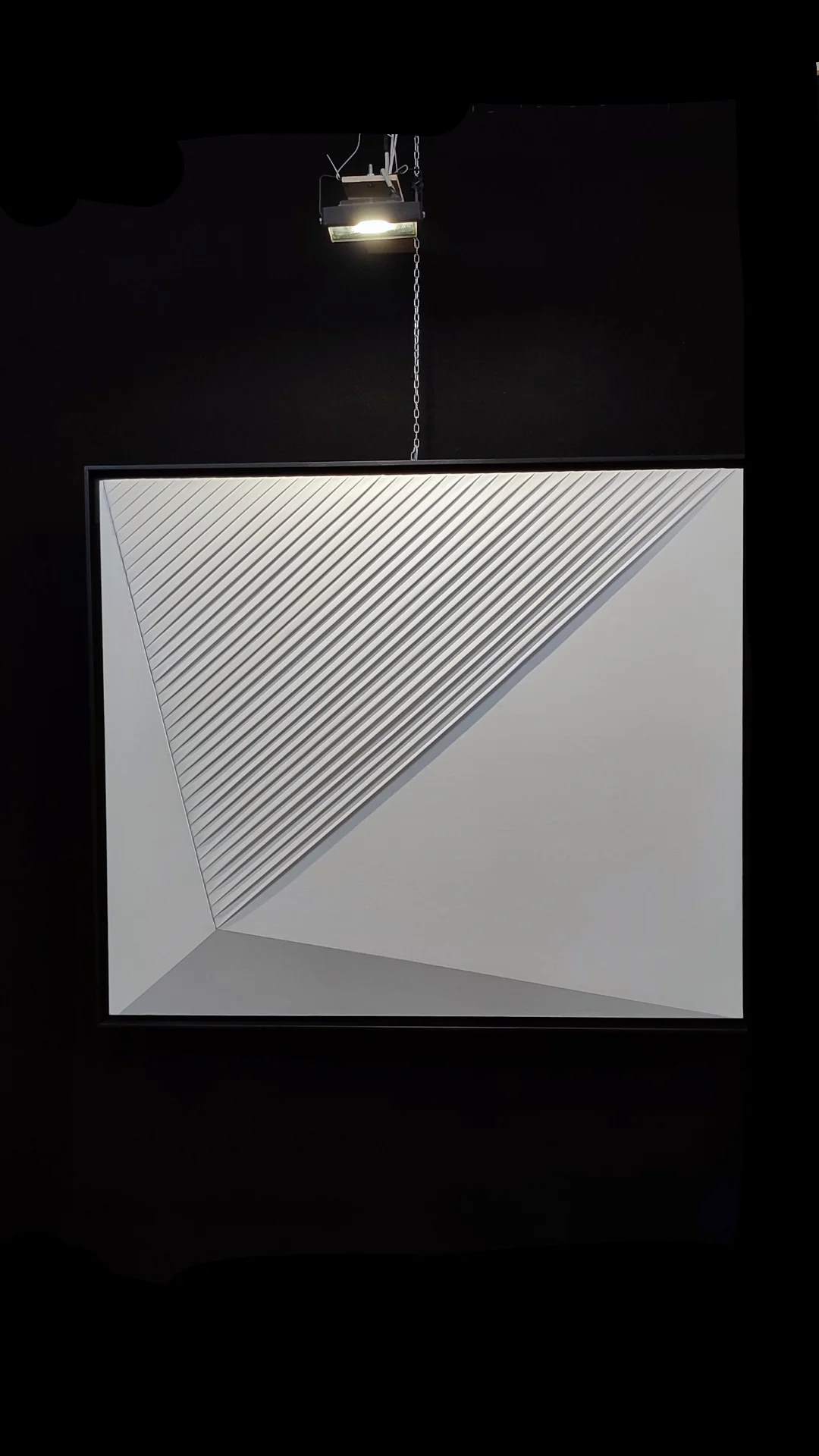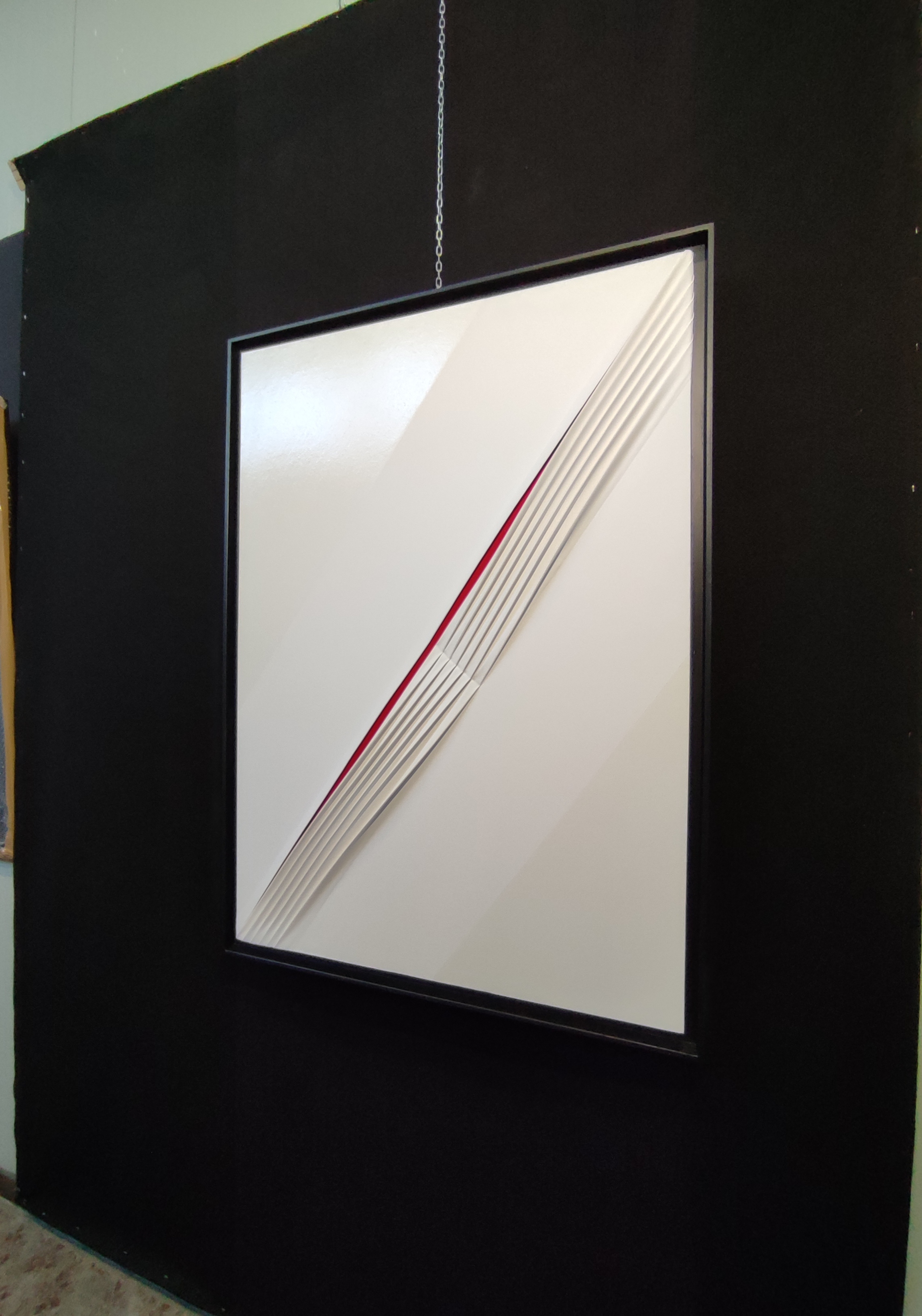

The emblematic core of his research: the Plissé series, in which the fold functions as a unit of meaning, repeated according to a rhythm that allows for no accidental variations
There is a moment, standing before Nando Stevoli’s canvases, when the gaze stops searching for an image and begins to measure a rhythm. The Plissé works, the emblematic core of his research, exist as a system: a visual syntax where the fold functions as the minimal unit of meaning, repeated according to a rhythm that allows for no accidental variations. When the support stops sustaining the image and becomes the image itself, painting has left its traditional definition behind to enter that territory which Gillo Dorfles, in 1966, christened pittura-oggetto - the label with which the critic brought together Fontana, Bonalumi, Castellani, and Scheggi in a Milanese exhibition.
A precise, entirely manual practice borders on mechanical perfection and witnesses to his level of control over the medium
It is within this genealogy that Stevoli’s practice finds its historical placement: not as a citation, but as the continuation of a problem opened up by Fontana with the monochrome and carried forward, through different paths, by Bonalumi and Castellani. This is the very same question that, in the 1960s, would prompt an entire generation to ask what remains of the painting once the illusion is stripped away. Stevoli identifies his own answer within the fold and has aligned himself, since 2016, with the Rigorism movement, which reinterprets that heritage through a language grounded in essentiality and the rigor of form. Furthermore, his vocabulary dialogues with American Minimalism and Donald Judd’s notion of the specific object, according to which the artwork coincides with a real, self-sufficient, and immediate presence in space.
He identifies his response within the fold and aligns himself with the Rigorism movement
The Plissé works translate that conception into an entirely manual practice, achieving a precision that borders on mechanical perfection and witnesses to the level of control exercised over the medium. The canvas abandons its function as a support to become an object: a threshold between the visible and the invisible, between geometric construction and perception. Each ripple generates a microclimate of its own shadows, capable of rendering different chiaroscuro compositions depending on the time of day and the angle of observation. The artwork thus evades any definitive viewing, living within the dynamic relationship between space, time, and the gaze - the very same dimension that Maurice Merleau-Ponty attributes to perception, a process fulfilled by the body in motion, not by the immobile eye. Stevoli’s method proceeds by subtraction: it eliminates the narrative, reduces color to the essentials, and entrusts all tension to the precision of form.
The canvas abandons its function as a support to become an object - a threshold between the visible and the invisible
The result dialogues with the culture of design and architecture rather than the tradition of easel painting. It is precisely within this divergence that the originality of his proposal is measured: the wager that the repetition of a single gesture, taken to its utmost discipline, can still generate visual complexity. With just a few elements - a fold, a surface, a luminous vibration - the artist demonstrates that painting can produce stillness, and that within that stillness is measured the most accomplished form of visual thought.
With just a few elements - a fold, a surface, a luminous vibration - he demonstrates that painting can produce stillness